How Does an LED Strip Controller Work?
An LED strip light controller acts as the command center for adjusting the color, brightness, and other effects of LED light strips. Remote controls and smartphone apps allow you to send commands to the strip controller, which adjusts the voltage and current to the LEDs altering their brightness and color output.

The easiest way to dim your LED strip lights is to choose a controller that has dimming capabilities. The vast majority of strip light controllers have built-in dimming options, and this allows for a simplified purchasing journey.
What To Consider When Choosing an LED Strip Controller and Dimmer
1. Strip Light Compatibility
There are several types of LED strip controllers: RGB, RGB+W, RGB+CCT, and single color controllers. Your strip light controller must be compatible with whichever strip light you want to control. Otherwise, your controller will not be able to control all the parts of your strip light. For example, if you used an RGB controller on an RGBW strip light, the controller would only be able to control the RGB diodes and not the white ones.
Additionally, some display options will be dependent on the functionality of your strip. For instance, a controller that can change the individual LED modules of an addressable strip light cannot give a non-addressable strip light the ability to be individually addressable. Identify the type of LED strip you have and choose a controller that fits those specifications.
2. Strip Light Display Options
Next, you need to decide what display options you want for your strip lights. Depending on what LED strip light you have, you can change the brightness, color, mode, and color temperature. These display options, however, are all dependent on the controller and remote option you choose. Some remotes are simple and have basic controls, while new smartphone apps offer advanced display options like preset modes and music sync. Think about what you would like your strip lights to do and where or how they will be installed to help decide whether a remote or smart app would best suit those needs. Keep in mind, some controllers are able to support both remote controls and apps if you aren’t sure which type of control you want or if you change your mind down the road.


3. Smart LED Strip Lights
There are a variety of controller types including ones that integrate into hub systems and connect with Bluetooth® and Wi-Fi. If you want your strip lights to integrate into a smart lighting system, be sure to choose a controller that is Bluetooth or WiFi-compatible.
Can I Dim My Strip Light Without Using a Controller?
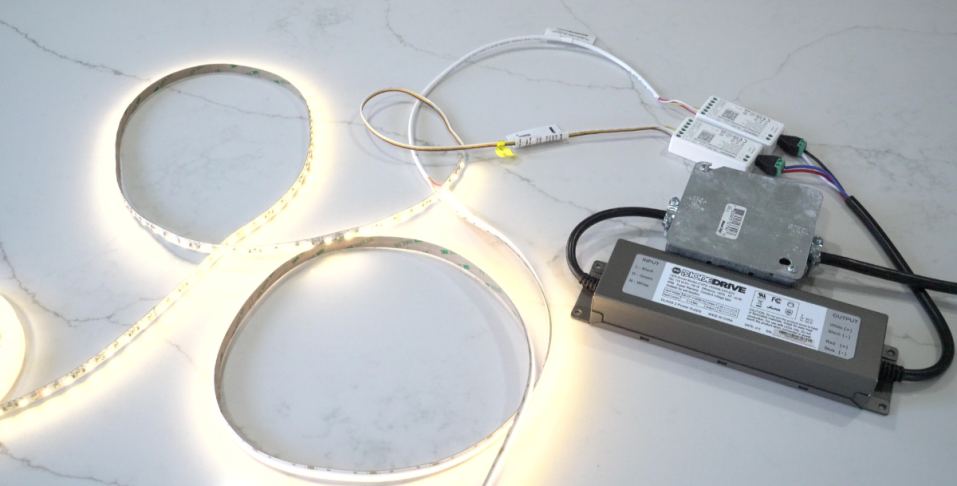
Yes, you can dim single-color strip lights without using a controller, but it will be slightly more complicated. You can use a power supply with either a TRIAC wall dimmer, a 0-10V dimmer, or a PWM controller. For all of these options, it's important to use a dimmer specifically designed for LED technology. Traditional incandescent dimmers may not work well with LED strips and can even damage them.
If you want to wire your strip lights directly to your 120V wall socket, you can use a TRIAC dimmer and dimmable power supply. The majority of LED strip lights are low-voltage, so the first step in connecting your strip lights to your home’s main power is converting the 120 VAC into the correct voltage for your strip light (usually 12V or 24V DC).
TRIAC (Triode for Alternating Current) dimmers control the current flowing through a load by rapidly switching the current on and off to create an average current supplying the brightness you need. If using a TRIAC wall dimmer, you must make sure your power supply can interpret the signals from your dimmer in order to correctly send the right current to your strip lights. To do this, you must use a TRIAC-compatible power supply or a dimmer with a built-in driver.

A second option is to use a 0-10V dimmer with a 0-10V dimmable power supply. In this setup, connect your strip light to one of the power supply outputs and connect the 0-10V dimmer to the low-voltage output wires.

Finally, if you have a single-color strip light that you want to control the brightness levels of, you can use a DC PWM (Pulse-Width Modulation) dimmer. This is installed between the power supply and your strip light.

Other Frequently Asked Questions
Can I control multiple LED strips with one remote?
Yes, it's possible to control multiple LED strips with a single remote, but this depends on whether the strip lights and remote are designed to do so. Some remotes are designed to control multiple zones or groups of LED strips, allowing you to synchronize their lighting effects or adjust their settings simultaneously. Make sure the remote and LED controller support multi-zone control if you intend to control multiple strips together. One popular hub system is the Wireless MiBoxer Smart Lighting Ecosystem which allows you to connect various smart lights and control them with one remote.

How do you connect LED strip lights to a controller?
To connect LED strip lights to a controller, you generally need to follow these steps:
- Ensure the controller is compatible with your LED strip type (RGB, RGBW, single-color, etc.).
- Connect the positive terminal of the LED strip to the corresponding positive terminal on the controller. Depending on the type of LED strip and controller, you also need to connect the RGB or RGBW wires to their corresponding terminals.
- Connect a power supply to the controller. Make sure the power source can supply the correct voltage of the strip light.
- Plug in the power supply and test the connection to ensure the LED strip responds to the controller's commands.
These steps might vary depending on the specific controller you have. Follow the manufacturer's instructions.
Can you control LED strip lights with your phone?
Yes, you can control LED strip lights with your phone using a smartphone app. Many modern LED controllers offer Bluetooth or Wi-Fi connectivity, allowing you to connect your phone to the controller and control the LED strips through the app. This provides convenient control over your strip light colors, brightness, and effects.
How do you control addressable LED strips?
Addressable LED strips, also known as individually programmable LED strips, require a controller that supports their specific technology. Brands like MiBoxer use a smart app that gives you the freedom to program and control individual strip light LED diodes to create complex patterns and effects.
Can you use any LED remote for LED lights?
Not all LED remotes are universally compatible with all LED controllers. Therefore, you must choose a remote that is specifically compatible with the controller you have. Most strip light controllers will state which remotes or apps they work with.
Complete strip light kits are available if you want to skip the hassle of finding strip lights, controllers, and remotes that work together. These kits come with everything needed for a strip light installation. If you have questions, don’t hesitate to call us toll free at 866-590-3533. Our customer service and technical support teams are available from 8:30 a.m. to 6 p.m. CDT Monday-Thursday and 8:30 a.m. to 4 p.m. CDT on Friday.

by Super Bright LEDs Experts
The Super Bright LEDs editorial team provides expert guidance on LED lighting solutions for commercial, industrial, vehicle, and residential use. Their trusted insights help businesses and homeowners make informed lighting decisions.
Get In Touch Email Us | 866-590-3533 | Live Chat